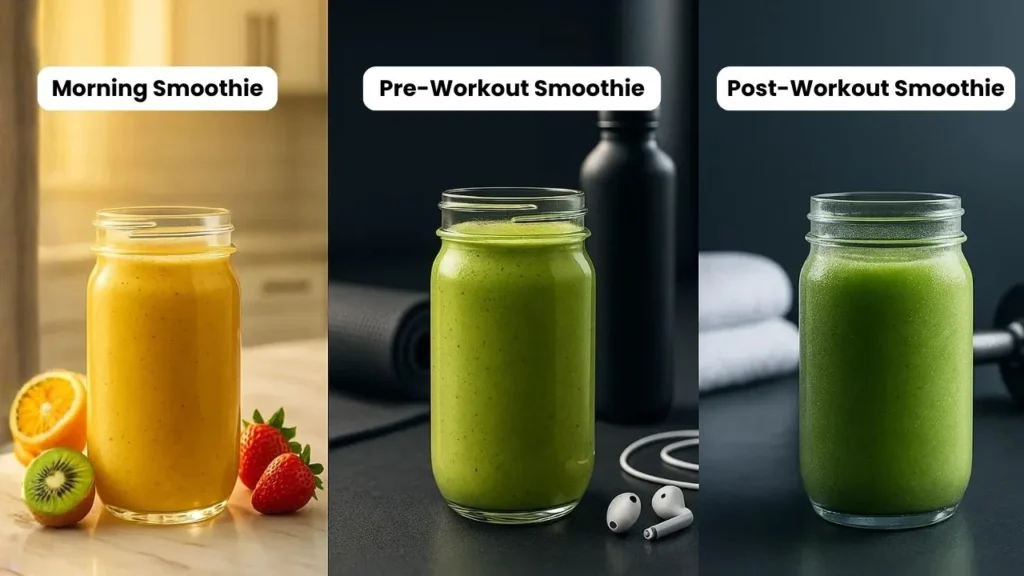
Short answer: The “best” time depends on your goal.
Smoothies aren’t automatically healthy; they’re as good as what you put in the blender. Dietitians recommend building them like mini-meals—whole produce for fiber, plus protein and healthy fats—so you get lasting satiety instead of a quick sugar hit.
Go for a balanced blend: produce (including greens) + protein (Greek yogurt, tofu, protein powder) + healthy fat (nut butter, chia) + liquid base. EatingWell’s RD guidance highlights that this combo turns a smoothie from a sugar rush into a satisfying meal. If you’re fully replacing breakfast, many hospital dietitians suggest a shake that actually eats like a meal (roughly 300–400 kcal with ~20–30g protein).
Make it work: Add oats or flax (fiber), keep juice minimal, and let fruit sweeten naturally.
Carbs are your main fuel; a little protein helps. The Academy of Nutrition and Dietetics guidance (as summarized by Nutribullet) recommends exactly that pattern before you train. Think banana + oats + milk + a half scoop of protein if needed.
Now the priorities flip: protein to repair muscle, plus carbs to replenish. Northwestern Medicine’s sports-nutrition example pairs protein powder with carb-rich fruit for a recovery smoothie—simple and effective.
If your “3 p.m. smoothie” is mostly fruit and juice, you’ll be hungry again fast. Keep the fiber and protein in the mix so energy rises gently instead of spiking.
You can do a small, protein-forward, low-sugar blend if it fits your day, but big fruit-heavy shakes late at night aren’t ideal for satiety or sleep. When in doubt, keep it light and balanced (think kefir + spinach + berries).
Dietitians often use a simple framework you can memorize:
Liquid (½–1 cup) + Protein (1 serving) + Produce (1–2 cups) + Healthy fat (1–2 Tbsp) + Optional boosters. This keeps macros balanced and fiber intact.
Builder ideas
Blending preserves fiber from whole produce; juicing removes it. That’s why a well-built smoothie is usually more filling than juice.
Morning “stay-full” base
Pre-workout fuel
Post-workout repair
Is morning the best time for a smoothie?
Morning is convenient and helps you bank produce early—just build it with protein and fiber so it keeps you full.
Pre- or post-workout: which is better?
Both matter—carb-forward before, protein + carbs after.
Are daily smoothies OK?
Yes, if they’re nutrient-dense (protein, fiber, healthy fats) and fit your overall diet. Watch added sugars and giant portions.